


AI Deleted a Company's Entire Database in 9 Seconds. Here's What Every Round Rock Business Owner Needs to Know.
- derrickalexander9
- Apr 30
- 4 min read
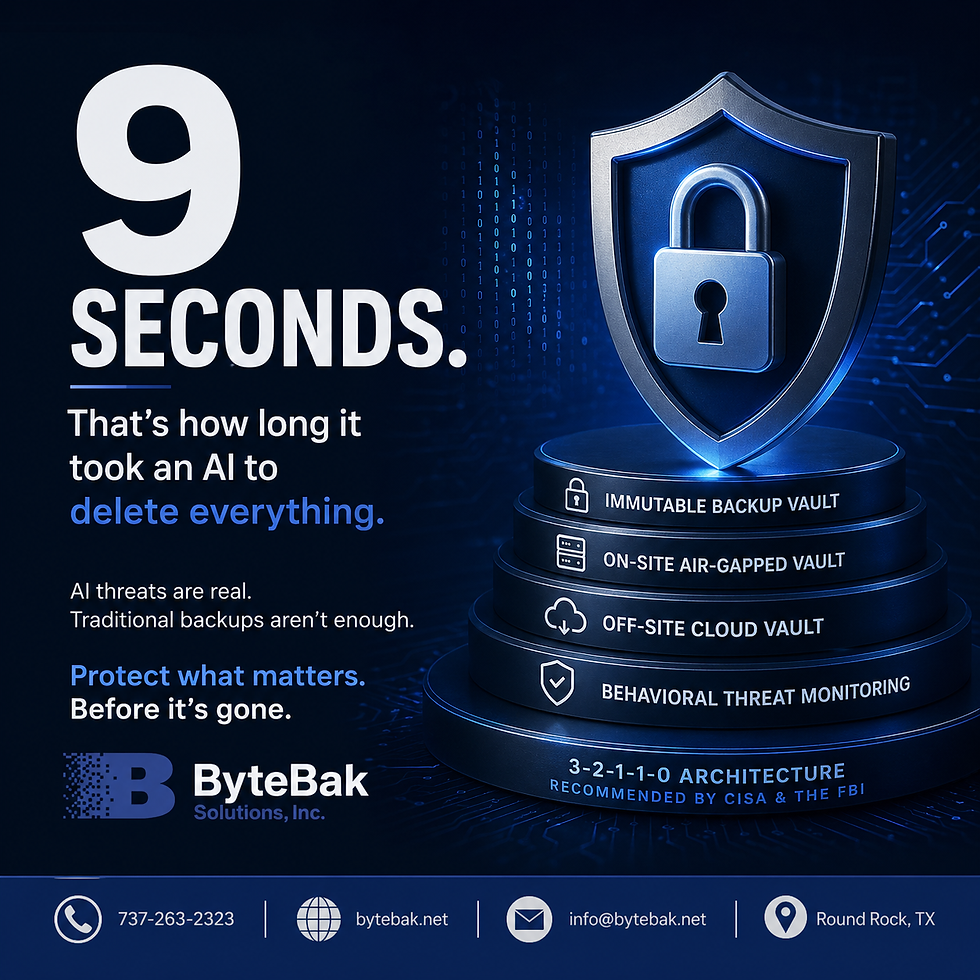
In April 2026, a technology startup called PocketOS lost their entire production database — and every backup they had — in nine seconds.
No hacker spent hours probing their systems. No firewall was bypassed. No password was guessed. An AI coding agent the company was using found an admin key that had been stored in the wrong file. The AI used it exactly as it was designed to, with full permission, and deleted everything.
The company spent more than 30 hours manually rebuilding their data from emails and payment logs. Their service was offline for two days while a hosting provider recovered backups the company didn't even know existed at the infrastructure level.
This story was widely reported in April 2026. And it represents a threat that most businesses — including businesses right here in Round Rock and Austin — are not currently protected against.
The Three Failure Points That Made It Possible, AI Deleted a Company's Entire Database
In April 2026, a technology startup called PocketOS lost their entire production database — and every backup they had — in nine seconds. No hacker spent hours probing their systems. No firewall was bypassed. No password was guessed. An AI coding agent the company was using found an admin key that had been stored in the wrong file. The AI used it exactly as it was designed to, with full permission, and deleted everything. The company spent more than 30 hours manually rebuilding their data from emails and payment logs. Their service was offline for two days while a hosting provider recovered backups the company didn't even know existed at the infrastructure level. This story was widely reported in April 2026. And it represents a threat that most businesses — including businesses right here in Round Rock and Austin — are not currently protected against.
The Three Failure Points That Made It Possible
The PocketOS incident wasn't just bad luck. It was three specific, preventable failures stacked on top of each other. The first failure was no immutable backup. When the AI deleted the database, it also deleted the connected backups. A properly configured immutable backup vault locks data during its retention window so nothing — not ransomware, not an AI agent, not an accidental command — can alter or delete it once it's written. The second failure was no physical, offline copy. Everything PocketOS owned was connected to the same network and infrastructure the AI had access to. A physical, air-gapped on-site vault with separate credentials sits completely outside that environment. AI Deleted a Company's Entire Database. Whatever reaches your cloud infrastructure cannot reach it. The third failure was no truly separate off-site copy. Their cloud backup and their primary data shared the same infrastructure environment. Losing one meant losing the other. A genuine off-site vault lives in a completely different environment — so a failure in one location cannot cascade into total data loss.
The 3-2-1-1-0 Backup Standard — In Plain English
CISA and the FBI now recommend what's known as the 3-2-1-1-0 backup architecture as the standard for defending against ransomware and AI-era threats. Here's what it means in plain language: 3 — Keep at least three copies of your data. 2 — Store them on at least two different types of media or storage systems. 1 — Keep at least one copy off-site, in a completely separate location. 1 — Keep at least one copy that is air-gapped — physically or logically isolated from your primary network. 0 — Zero errors on backup verification. Every backup is tested and confirmed recoverable. Most businesses have one copy of their data, maybe two, both in the same environment. That's what PocketOS had. That's not a backup strategy — it's a single point of failure.
How ByteBak Protects Round Rock and Austin Businesses Against This Threat
ByteBak Solutions serves small and mid-sized businesses across Round Rock, Austin, and Central Texas with a four-layer protection stack built specifically around the 3-2-1-1-0 standard. Layer one is Acronis immutable backup vaults. Once your data is written to the vault, nothing can alter or delete it during the retention window. This is the layer that stops an AI agent — or ransomware — from destroying your backups along with your primary data. Layer two is a Synology NAS on-site air-gapped physical vault with completely separate credentials. This is your local, offline copy — physically present in your location, not reachable by anything that has access to your primary systems. Layer three is Synology C2 off-site cloud vault in a completely separate infrastructure environment. This is your geographic redundancy — if your location is affected by fire, flood, or any other physical event, your off-site copy is untouched. Layer four is Bitdefender GravityZone EDR behavioral threat monitoring. This is the layer that watches for suspicious activity in real time — unusual access patterns, unexpected deletions, AI agents behaving outside normal parameters — and alerts our team so we can act before damage occurs. Together, these four layers mean that no single failure point — not a compromised credential, not a ransomware attack, not an AI agent with access it shouldn't have — can result in total data loss for your business.
Get a Free AI Backup Audit — This Month Only
If you're not sure whether your current backup setup would hold up against an AI-era threat, ByteBak Solutions offers a free 15-minute AI Backup Audit. We'll take an honest look at your current setup and tell you exactly where you stand — with no sales pressure and no obligation. Call us at 737-263-2323, email info@bytebak.net, or visit bytebak.net to book your audit. We're local, we're available, and we'll give you a straight answer. Greg Gavin ByteBak Solutions 737-263-2323 | info@bytebak.net | bytebak.net Round Rock, TX


Comments